Henderson Truck Suspension Repair - St. Louis Truck Driveshafts, Suspensions, Brakes 314-516-9466

Menu:

Hendrickson Truck Suspensions Maintenance and Repairs

Hendrickson’s official name for the walking beam suspension is “equalizing beam”.  It is also known affectionately as a “bogie”.  In any case Plaza gets a lot of repeat business for these suspensions for a good reason. We offer fast turnaround at a good price.  And we have continued this tradition with the maintenance of all of Hendrickson's air suspensions as well.
 
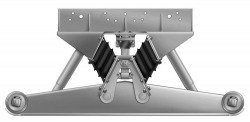
A Hendrickson HN Suspension has no center beam bushing making for easier maintenance
The Hendrickson HN 402/462 suspension series

HN 402/462 Maintenance

 
Beam End Bushing Replacement

Beam end bushings on any Hendrickson walking beam require similar maintenance. We look for distorted or frayed rubber. Rubber on the bottom usually shows a gap. Because rubber end bushings are always compressed with the load bearing on the top side, the lower side of the rubber is not subject to that same pressure and the rubber tends to move inward producing a gap. You can test these bushings by placing a jack under each beam end and checking for movement of the rubber and end bushing inner casting.

We remove worn bushings by pushing them out with a 100 ton hydraulic press. Because walking beams are heat treated for strength and service life you should not attempt to use a torch to remove any beam bushings. The use of heat will adversely affect the strength of the beam. If you have walking beams (or torque rods) needing new bushings, consider removing the beams and bringing them to Plaza.

 
Maintenance of Bolster Springs

We often replace the bolster springs. The first place to check for wear is the place at which the rubber is connected to metal.  A slight separation of the rubber from the metal is acceptable but only up a depth of approximately 1 ½”. At other places on the surface of the rubber gradual breakup of the surface is normal but cuts or splits of over 3” in length and an average depth of 1” should be considered as possible points of failure. Creases in the rubber can be ignored. Oil and grease contamination is not usually a problem.

The auxiliary spring is also important. The normal height of an “unloaded” auxiliary spring is 4”. Replacement is recommended when the height of this spring decreases to 3 ½” or below.

RT/RTE Suspension Maintenance

 
Beam Center Bushings

The beam center bushings control the lateral movement of the axles during cornering. Rubber center bushings permit more movement than bronze bushings. Rubber can allow up to 3" of lateral movement under load. Normal wear is evidenced by the rubber shredding from each end of the bushings. Worn center bushings will allow increased lateral movement of the axles on turns beyond 3" and allow the inside walls of the tires to rub on the suspension frame hangers. Therefore lateral movement in excess of 3” is a warning that the center bushings should be replaced before tire damage results. 

Bronze center bushing wear can be checked by raising the saddle with a jack. Saddle movement of 0.125" or more before the beam raises indicates excessive wear, and the bushing should be replaced. Unlike rubber or urethane bushings, bronze bushings need frequent lubrication. Grease must flow to the bottom half of the bushing. To insure that this happens remove the load from the bushing by lifting the rear of the vehicle before applying grease.
Plaza was acknowledged in 2009 by HENDRICKSON for our expertise in the service of Hendrickson suspensions. Click here & check it out.